
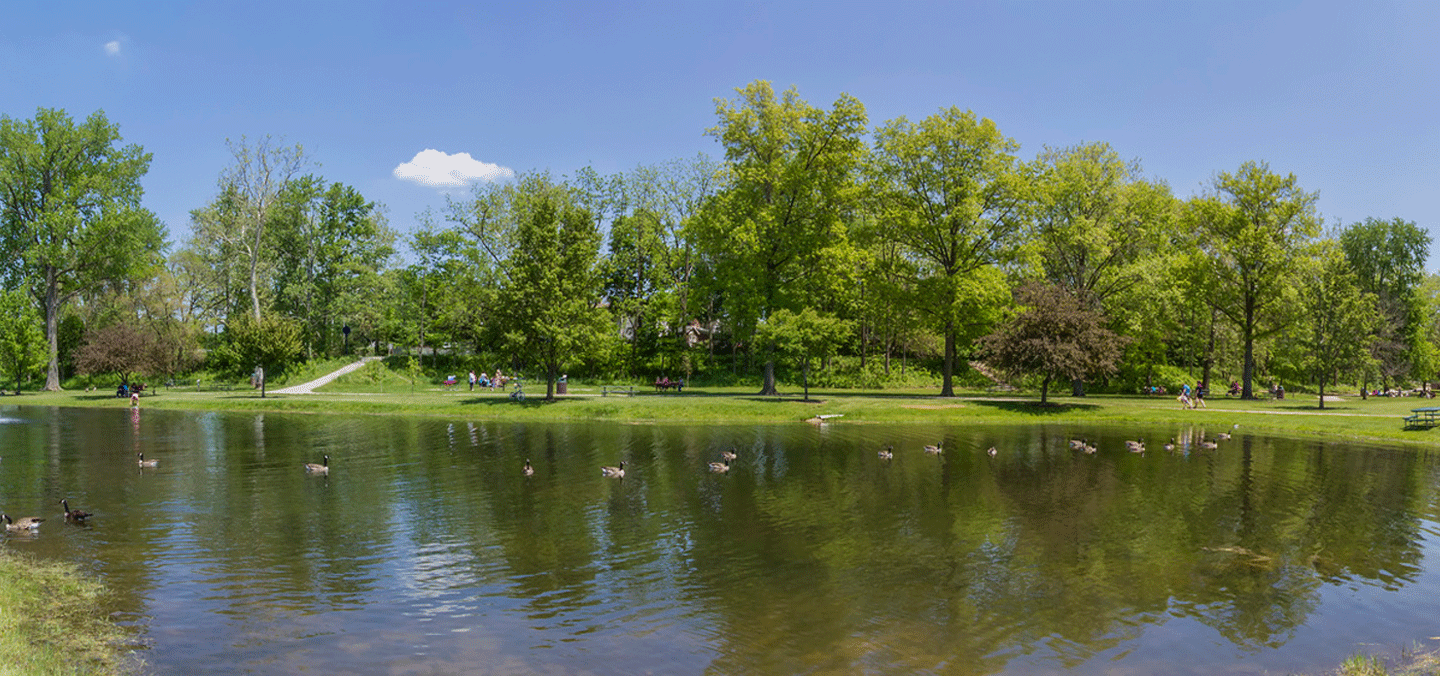
Shanklin Park Pond

E-Blog
Learn what Environmental Resilience is all about.
Mission: To care for Goshen’s unique ecosystems as we care for Goshen’s neighborhoods.
Goshen Water Department Wellfield – Prairie Restoration
The prairie at 4106 Dierdorff was planted in 2024 as part of a project to naturalize and protect 48 acres that will become part of the city’s wellfield. The effort brought together the Goshen Water Department, Environmental Resilience Department, Goshen AmeriCorps through the Michiana Area Council of Governments, the U.S. Fish & Wildlife Service and the Bee and Butterfly Fund.
Prairie and pollinator habitats support bees, butterflies and moths that continue to decline because of habitat loss, climate change and pesticide use. Monarch butterflies migrate through the Corn Belt, where native habitat continues to disappear because of development and agricultural conversion. Over the past decade, the monarch population has declined by about 70 percent.
Future plans include a public walking path that will allow residents to enjoy the prairie and observe native wildlife. The restoration will be the largest habitat restoration project undertaken by the City of Goshen. It also will help protect the city’s future wellfield while expanding access to natural spaces. Seed mixes planted in the prairie are listed below.

Business Planting in Goshen Reaches 295 trees this year
June 30, 2026

Thanks to Goshen’s IRA Forestry grant, thirty businesses in grant-funded areas were able to receive free 3-gallon-sized trees to be planted on the property. Most of them also received free planting from Department staff, AmeriCorps Members, and volunteers. Trees were planted to provide cooling for employees, reduce air conditioning needs, and improve the aesthetics of properties. Some businesses added trees to provide spaces for wildlife habitat. Business tree plantings reached 295 during this first half of the year.
Funding for this program is provided by the Inflation Reduction Act and the USDA Forest Service, Urban and Community Forestry Program, in partnership with American Forests. USDA and the City of Goshen are equal opportunity providers and employers.
Mass Planting Project across from Goshen Wastewater
May 19, 2026

Goshen High School Cheerleaders partnered with Goshen AmeriCorps, Volunteers, and the Department of Environmental Resilience to plant 400 native trees across from Goshen’s Wastewater Treatment facility on Wilden Ave. The trees were purchased from the Indiana Department of Natural Resources Tree Seedling Nursery. This planting will add wildlife habitat, improve the riparian corridor, increase Goshen’s tree canopy and economic resiliency by reducing acres of mowed turf grass. Thank you Goshen Wastewater Utility!
Funding for this program is provided by the Inflation Reduction Act and the USDA Forest Service, Urban and Community Forestry Program, in partnership with American Forests. USDA and the City of Goshen are equal opportunity providers and employers.
Providing Support to Local Food Forests
May 22, 2026
Goshen Health Vista and Silverwood Mennonite continue to participate in Goshen’s Food Forest Program. The Food Forest program is an initiative where Goshen Environmental Resilience has worked with local organizations to develop two local food forests, one at Vista Health and one at Silverwood Mennonite Church. In May, Environmental Resilience moved from Rieth Interpretative Center to our new offices at 524 E Jackson Street. The property across the street is becoming the home of a third food forest. The food forest model can be compact but full of a steady supply of fresh, healthy, and convenient food. These food forests are established to serve the public and demonstrate the possibilities for a backyard setting through small-scale garden cultivation.
Perennial herbs and edible plants were added to all the sites as well as a few annuals to help round out the summer’s bounty.
AARON SAWATSKY-KINGSLEY: Come celebrate Arbor Day during First Fridays
Apr 25, 2026 ran in the Goshen News
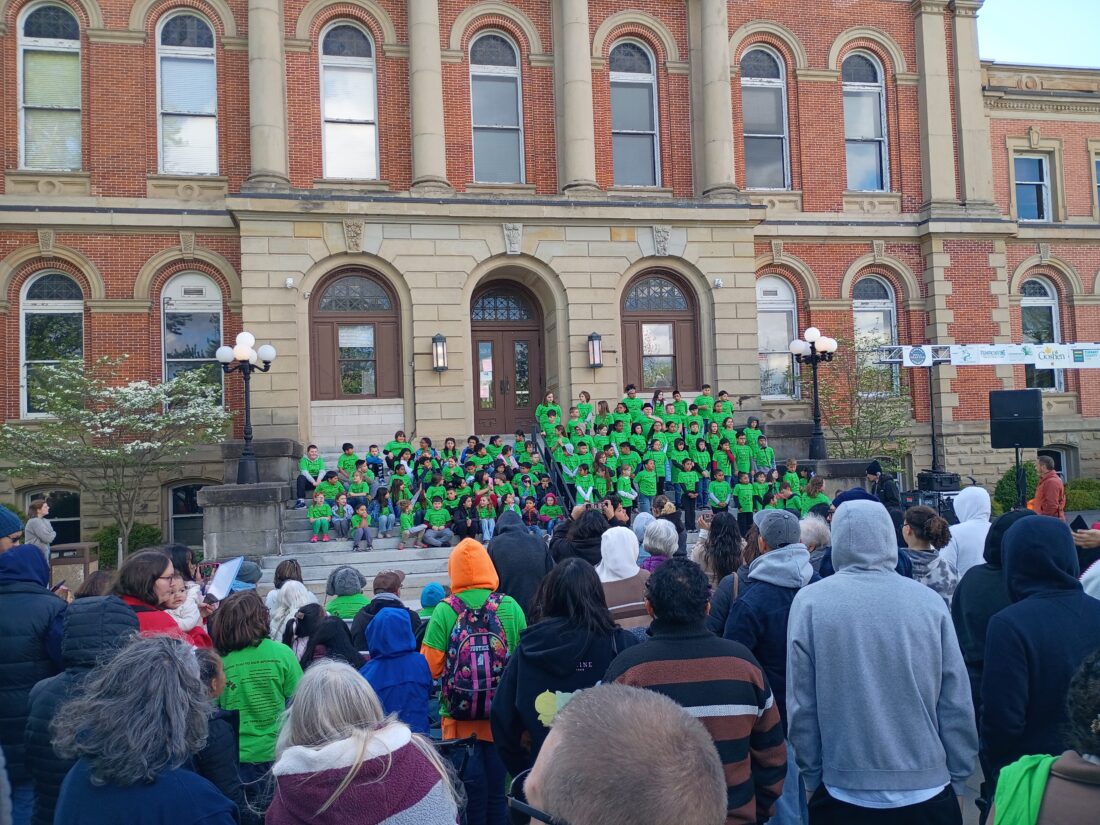
Arbor Day will be celebrated in Goshen this upcoming Friday. The event will be held at the Historic Elkhart County Courthouse, on Main Street, in conjunction with First Fridays Green Day, from 5-9 p.m. This will be a big party to help all of us recognize how important trees are in our city, our neighborhoods, and right outside our homes. It will be the 30th year that the city has hosted an Arbor Day celebration.

Arbor Day was first celebrated in the United States on April 10, 1872, in the state of Nebraska, where an estimated 1 million trees were planted. Cities and towns of all sizes, all around the world, now celebrate Arbor Day in a wide variety of ways, as a recognition that trees are an essential part of our urban fabric.
Goshen has a long history of planting and caring for trees. In 1847, a meeting of Goshen residents created a 12-person committee to oversee tree planting along streets and the public square, according to “Goshen’s First 150 Years: 1831 to 1981” (1981, The News Printing Company, Goshen). This committee was charged with the task of surveying and staking the location of every tree to be planted, and then gathering pledges of time and money from Goshen residents for this work. The tree committee was given authority to decide where the planting should begin and the variety of trees to be used. More than 170 years ago, Goshen already had a good eye for diversity: the committee told residents that “no forest trees shall be planted but maple, elm, hickory, black and white walnut, oak, coffee nut, pine, cedar, white ash, sycamore, wild cherry, hemlock, birch, balm of Gilead and mulberry.”
By the 1890s, Goshen was nicknamed the Maple City, with an increasing number of businesses using that moniker in their names. With good reason: lots of maple trees were being planted in the city, along streets, in yards, at churches, and around the County Courthouse (photos from the early 20th Century show the courthouse surrounded by a manicured forest of trees). Silver maple, sugar maple, red maple, and Norway maple began to dominate. The Maple City identity rooted deeply, and helped residents to feel responsible for the care and health of their trees.
This identity with maples likely helped Goshen to avoid the worst scenarios of Dutch Elm Disease devastation, which swept through the eastern parts of the United States in the middle part of the 20th Century. Many cities and towns had planted large percentages of elm, which succumbed to this invasive fungal disease. While Goshen certainly suffered elm losses from this disease (and still does to this day), it was likely nowhere near as bad as many other cities. In fact, the same is true when we look at the Emerald Ash Borer phenomenon of the past 20 years: while we certainly lost most of the ash trees in Goshen to the appetite of this invasive insect (ash represented about 6% of Goshen’s public trees in 2009, compared to 50% maple), its nowhere near the losses that other municipalities faced with 15-25% ash populations. Relying on maples dampened the effects of those disasters.
We still call ourselves the Maple City in 2026 — it’s still a really important part of our identity, linking us to the ecological history and health of our place, helping us to see ourselves in a broader natural context. We also understand now that we can’t rely only on maples — or any other single tree species — to hold up our urban tree canopy. There are invasive insects which are capable of destroying maples (Asian long-horned beetle, for instance), in the same way that elm and ash were destroyed. The health of our urban tree canopy and our urban forest depends on a wide diversity of tree species. This means that over the next 19 years as we increase our tree canopy to cover nearly half of the city (45% canopy by 2045), we will plant lots of non-maple trees in order to move toward an urban forest population where maples represent closer to 20% of all the trees. That will still be the largest species by percentage, so we can still call ourselves the Maple City.
Our Arbor Day Celebration on May 1 will be a chance to learn a lot more about trees and our urban forest. It will also be a lot of fun. We’ll have singing from elementary choirs beginning at 5 p.m.; there will be more live music through the evening; there will be face painting and magic; there will live animals and tree climbing; there will be lots of trees to take home and plant; there will be good food to eat. This will be a great way to remember that caring for trees is caring for people.
Aaron Sawatsky-Kingsley is Goshen’s urban forester and director of the Department of Environmental Resilience. He can be reached at [email protected] or at 574-537-3850.
AARON SAWATSKY-KINGSLEY: Goshen to remove 150-plus street trees through grant
Jan 16, 2026 ran in the Goshen News
Tree removal is a necessary part of managing an urban forest, such as the community of trees we live with in Goshen. There is a lot about removing trees that is challenging — cost, difficult conditions — but it is eventually necessary for nearly every urban tree to be removed in order to protect people and property. Street trees present unique considerations related to removal because these trees embody both public benefits and public safety realities. This winter, Goshen’s U.S. Department of Agriculture Forest Service grant will fund removal of 150-plus street trees in grant-approved neighborhoods around Goshen. This is a big deal.
The grant, awarded in 2024, does not cover forestry-related costs across the entire City of Goshen. This means that not all neighborhoods are eligible for grant-funded street tree maintenance. Goshen Forestry Division staff have worked hard over the past months to determine which trees in eligible neighborhoods are the best candidates for removal. The most important criteria is condition of the tree with regards to public safety: what are the risks that a given tree’s condition pose for the public? Another criteria — also supported by the grant — is removal of invasive tree species: where can we remove invasive street trees to protect both our ecosystem and public safety?
Losing these street trees will change their neighborhoods. The work which these trees have done across their lifetimes — patiently, generously, gracefully — can’t be replicated by anything other than a tree, and can’t be replaced with another ready-made, off-the-shelf product. These trees have been important place-making features for 50-100 years, making them familiar landmarks for many, and a welcoming, beloved friend for some who have known them. Over their lifetimes, they have produced large amounts of shade (cooling homes and pavement), captured large amounts of stormwater, removed air pollution which improves physical healthy, and greened neighborhoods which improves mental health. Losing these trees hurts.
One of the most important and sensitive aspects of managing an urban forest is deciding when to remove a large, valuable, productive tree. Its rarely an easy decision. Unfortunately, trees with these characteristics can simultaneously have declining and deteriorating conditions; when this is true, the risks which these trees pose can be serious. And of course, the larger the tree, the greater the risks, and the greater the cost for removal. These are exactly the kinds of trees which are targeted for removal: our USDA grant is a fantastic opportunity to remove costly street trees to improve public safety.
As mentioned above, removal of invasive trees is another aspect of this project. In particular, removal of Callery pear trees along Third Street is a focus. When these trees were planted more than 20 years ago, they appeared to be a good selection for this site: tolerant of the worst urban pollutants, compact form, pretty flowers. They continue to be these things, and have done really admirable work in a very tough site: I really appreciate these trees in many ways. However, they have two big strikes against them.
Strike one is their invasive nature. While these trees (sold all over the U.S.) were supposed to be sterile, they are not. Their seeds are spread everywhere by birds; the seeds grow readily in wild and semi-wild land, crowding out native plants and trees because there are very few natural predators or pests that control them. They form thick, thorny colonies, reducing biodiversity in our landscapes, which ultimately makes all plants more susceptible to disease and pests. We work regularly at removing these invasive offspring at various parks, trails, and along the millrace.
Strike two is that these pear trees characteristically have weak branch attachments. This means that limbs are prone to breaking and failing, especially as they age. Many of the Callery pear trees planted in the public right of way (such as the Third Street median) are reaching the age at which this kind of branch and limb failure begins to happen. Breaking and failure severely disfigures pear trees, further compromises their stability, and requires near-term removal.
With current municipal budget cuts, and the potential for further cuts in coming years, local funding for this work will be increasingly difficult to obtain. This makes our grant funds for this work all the more valuable. Added to this is the fact that the grant also pays to replant new trees for all those removed. We are fortunate to have this opportunity at this moment.
Aaron Sawatsky-Kingsley is Goshen’s urban forester and director of the Department of Environmental Resilience. He can be reached at [email protected] or at 574-537-3850.
Active Transportation in Goshen
Posted 12/14/2022 Written 11/14/2022 Conrad Liechty, Goshen College Sustainability Student Intern
This week, I had the opportunity to spend the morning with one of the Department’s two AmeriCorps volunteers, Shae Dirks. She’s been with the department for about two months now, with much of her work focusing on improving Goshen’s bikeability. One of the primary groups that she’s working with is the League of American Bicyclists, which certifies both communities and businesses with different levels of bike-friendliness. The city is actively working on improving its certification level from bronze to silver, and several businesses – including the Electric Brew, Goshen Brewing Company, the Maple City Market, and Goshen College – are also trying to get their first level of certification. If Goshen College succeeds, that would make it the third college in the state to be certified, behind Indiana University and Purdue.
In order to improve or become certified, entities need to meet a set of criteria in the following categories: Equity and Accessibility; Engineering; Education; Encouragement; Evaluation and Planning. The goal in any of these categories is to remove or reduce barriers that might prevent residents from choosing to bike. Right now, Shae is focused on improving access for less represented communities, including women and less affluent communities. Primarily, this has to do with physical access to bikes and bike infrastructure, but it also relates to education and safety training. She plans to help the city a host female-only bike event, to help the female biking community connect and feel more secure in Goshen.
Meanwhile, the Maple City Market is also actively working on making biking a more appealing choice for both their employees and customers. They have been offering a reward punch card for quite a while, offering customers a free baked good if they make their shopping trip on bike for ten weeks. One of their employees, Sarah, has started to advocate for offering maintenance and safety classes for employees. Through her connections in the biking industry, she has also suggested that the city could try to find a sponsor for improved bike parking and expanded bike lanes, especially in the downtown area. Sarah and Shae also discussed collaborating on a “Bike to First Friday” event once the weather is more friendly to bikers.
Maintaining Large Trees in the Canopy
Posted 12/14/2022 Written 11/3/2022 Conrad Liechty, Goshen College Sustainability Student Intern
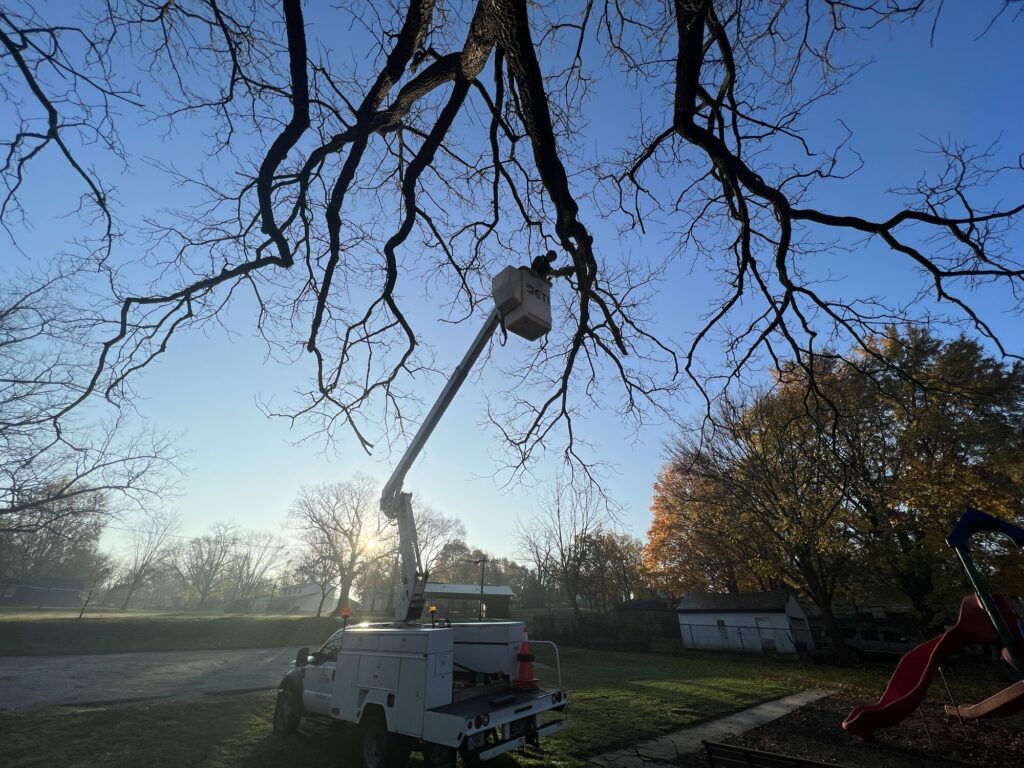
This past week, Kendel and I had access to one of the Street Department’s bucket trucks to take care of some much needed tree trimming. Unfortunately, since the Department of Environmental Resilience is a fairly new department, it doesn’t have all of the resources of the City’s larger departments, but they’re able to borrow everything they need from others around the City. This does mean that a fact of life for the department is waiting for others, but luckily we were able to use that time this morning to prepare our chainsaws and other equipment for the job. Once we got the call that the truck was ready for us, we drove over to the street department to pick it up, and then made our way to Walnut Park for a morning of work.
Both of the trees that needed work were large, old trees – one red oak, the other a walnut that the park might have been named after. Each had a couple of dead branches that had potential to cause property damage, or further damage to the tree if a nasty gust came through. Having these taken care of will help the trees heal and regrow into the newly vacant areas, improving their future life.
Maintaining city trees is a big part of the job for the Department of Environmental Resilience – with hundreds to keep track of, having a running list of trees that need work is an important task. Kendel keeps a list of every big tree that needs the bucket truck for maintenance, and otherwise trees are generally taken care of as quickly as possible. Some trees need more extensive work than others, with the majority being handled by a small chainsaw and a ladder.
We were able to finish our work in just over two hours before breaking for lunch, leaving behind a few piles of branches to be picked up later. Kendel, being much more qualified than myself, handled all of the bucket truck work, while I helped guide his bucket from the ground and cleaned up debris. If you see a tree with dead-looking branches or other issues, give us a call – we’d love to help or advise you on how best to take care of it!
Goshen Canopy Sustainability
Posted 12/14/2022 Written 11/3/2022 Conrad Liechty, Goshen College Sustainability Student Intern

Residents of Northwest Goshen – look out for new trees coming your way in the next few weeks!
Today, most of the Department’s staff went out to survey our proposed planting spots throughout the area. We recently called in NIPSCO and the Water and Sewer department to check for underground utilities, and having confirmed where their pipes are located, we are now nearly ready to begin the actual planting process.
Starting around 9am, we trekked around the neighborhood with stakes, spray paint, and Sharpies in tow, visiting each staked location in turn to make certain that the tree wouldn’t grow into the way of any utilities. If they might, we either relocated the stake or changed our plans to plant a smaller tree there. Along the way, we got to interact with several homeowners, excited to have trees planted in their lawns. We had enough time to get to all of the planting locations that we needed to check, so the trees should be able to be planted within the next 2-3 weeks!
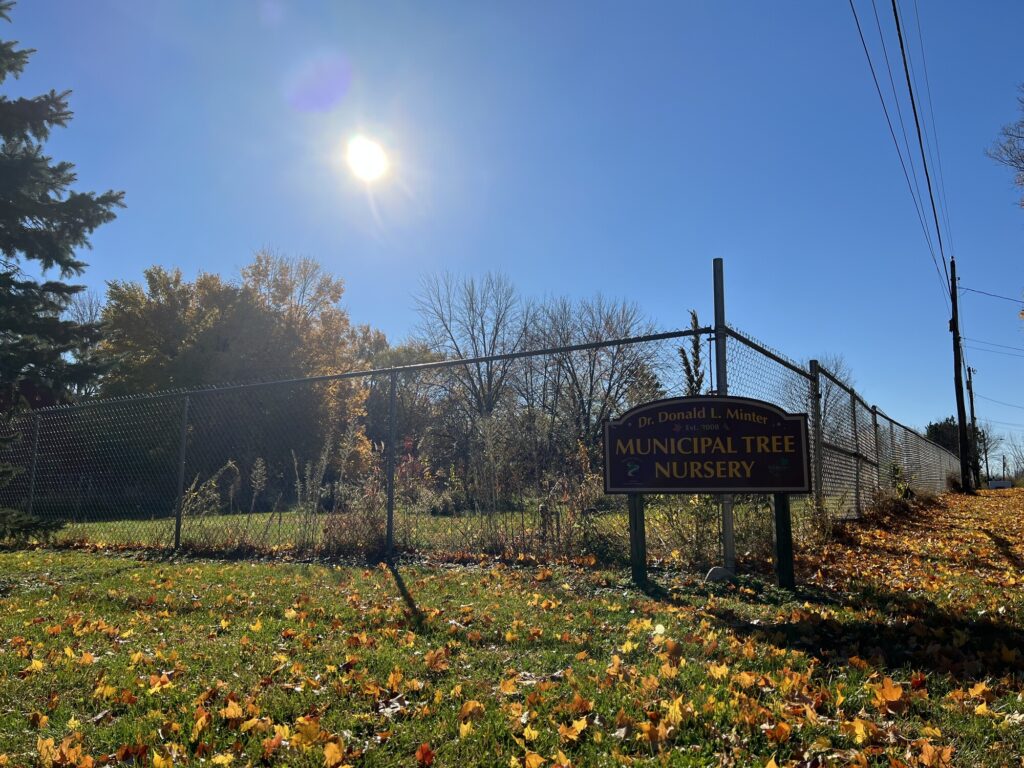
After checking on our planting locations, we stopped by the city’s tree nursery to see how the seedling trees are doing. Perhaps most exciting, there are nearly forty red oak seedlings, the offspring of Big Red (one of Goshen’s largest, oldest trees). These should be ready to plant within the next 3-4 years, if all goes well, and the City plans to continue harvesting acorns from Big Red for this same purpose. The rest of the nursery is flourishing as well – there are many different tree varieties that will soon be ready to take their places in residents’ yards. This nursery is particularly exciting: it allows the City to buy trees very young, or grow their own, saving potentially thousands of dollars compared to buying ready-to-plant saplings. It’s also fun to be able to trace where these trees came from, since many of them are offspring of well-established local trees!
Stormwater and Resilience
Posted 10/26/2022 Written 10/20/2022 Conrad Liechty, Goshen College Sustainability Student Intern

Most of the Department gathered early this morning for a planting project next to City Hall. In the crisp fall weather, we picked out a selection of native species, including echinacea and bee balm, and brought them out to what used to be a parking spot and is now home to a growing tree. When we arrived, we were met by Jason Kauffman from the Stormwater Management Department, who’s been the lead on this tree’s planting and success. He explained that while the tree has been greatly successful in reducing stormwater runoff from the parking lot, adding smaller plants around it would improve the drainage even further. This tree has been known for water pooling around it after major storms, which is dangerous for the tree and bad for the longevity of the surrounding parking lot. These native species should serve a multitude of purposes – beautifying the space, attracting pollinators, reducing heat, and helping the tree to drain, among others.

The four of us spent about an hour and a half digging holes, planning where to plant, and settling the plants into their new homes. Presently, the area looks fairly dead since many plants weren’t happy in their potted homes. However, come springtime, it should bounce back to life and bloom into a multitude of colors. The City is considering adding a bench to the space as well, which would be a nice resting place along 5th Street or a pleasant lunch spot for employees working in City Hall.
Native plantings like this one are a great way to improve the sustainability and beauty of your own property. They can be highly successful even on a small scale and will encourage more wildlife species to visit your property. Even better, they require almost no maintenance and return every year on their own, making your life as a homeowner even easier. For more information, I would suggest this excellent resource from the Indiana Native Plant Society.
Tree Evaluation
Posted 10/26/2022 Written 10/13/2022 Conrad Liechty, Goshen College Sustainability Student Intern

Today, I got to spend the morning with Aaron Sawatsky-Kingsley, learning about the process of evaluating trees and getting a little bit of a tour of some of the oldest trees in the city. The first tree that we took a look at was for a resident who called in to note some concerns that they had. This specific tree looked about 70-80 years old to Aaron’s eye. Some of the concerns noted by the resident related to cracks and older sections of the tree. During Aaron’s analysis, he noted that several areas of the tree are dead or dying, but that isn’t out of the ordinary in an older tree such as this one. At the end of the evaluation, Aaron concluded that the tree could use some maintenance but provides significant benefit to the property owner. Maintaining the tree to prevent property damage is wise, but removing the tree would not be the best action. On our way back, we also visited “Big Red,” a massive 200-plus-year-old Red Oak.

We also had the opportunity to check in on another ongoing project, the fall tree planting. The City is planting around 140 trees, and Trees for Goshen has sponsored another 250. In preparation for the planting to happen as soon as possible, the department has been staking out planting locations in lawns and will be calling in utility companies to make sure locations are approved for plantings within the next few weeks. These plantings need to be done while the ground is still warm enough to dig in, so the department is committing a lot of resources to make sure this happens in time. Aaron mentioned that this planting is mostly in Northwest Goshen, which is part of his plan to rotate plantings throughout the city every 7-10 years. This project aims to maintain a mixed, healthy canopy of varying ages so that as one group of trees ages out, the canopy will not be devastated. While explaining this project to me, Aaron noted that while he won’t be alive to benefit from his work, he still prioritizes it so that his kids and future generations will have a healthy, green city to live in.
Ewwwwwww!
Posted 10/10/2022 Conrad Liechty, Goshen College Sustainability Student Intern
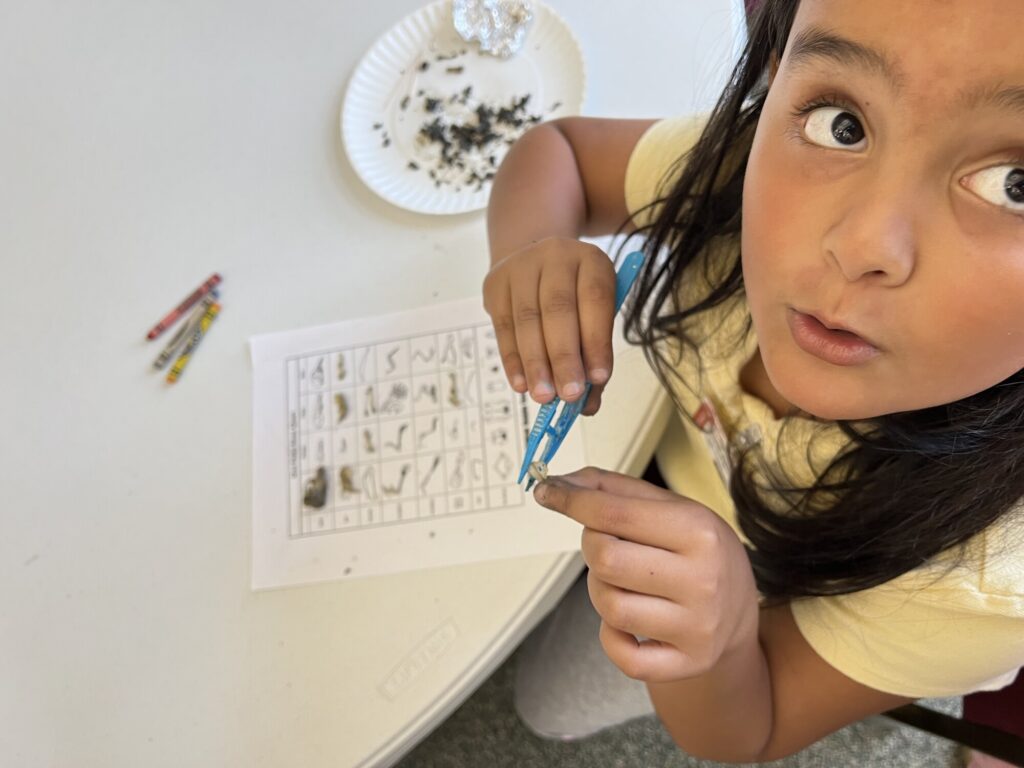
Recently, Rieth Interpretive Center was host to three classes of second-graders from West Goshen Elementary School. They joined our staff for a day of exploration, owl pellets, and early October sunshine and got to spend their whole school day with us!
The group I helped with started with an owl pellet dissection. While many of the kids approached their pellets with a bit of hesitation, when they eventually dug in, they found all kinds of bones! Some of them were lucky enough to find entire, intact skulls buried in their pellets, but everyone was able to pick out some leg bones and learn a little bit about how owls hunt and digest their prey.

After they finished with their pellets, students washed their hands and got to explore the Rieth Interpretive Center! They were excited to find a collection of child-sized binoculars – as one student announced, “I wish we could come here every day!” The small collection of taxidermied animals did unnerve them, but they moved past that and on to more exciting activities quite shortly.

The next major activity was a guided hike and nature education session in the Dr. Larry Beachy classified forest. Aaron Sawatsky-Kingsley gathered one group of around 20 students around to encourage them to stay quiet during the hike. As we trekked into the woods, he related through various comparisons the basics of how the forest ecosystem works at a level that a second grader can grasp. The students met Aaron’s declaration that good soil is mostly bug poop with a chorus of “Ewwwwwww”s, but were excited to hear him say that “Everyone owns the forest.” Several keen-eyed visitors spotted a squirrel feeding high up in a tree, and we were all treated to plenty of birdsong, although none of the birds decided to present themselves.
Throughout their visit, students also enjoyed lunch outdoors in Shanklin Park and some structured playtime guided by their teachers. We hope their visit sparked curiosity about the outdoors and helped them recognize some of Goshen’s resources!
Solid Waste Services
Posted 10/3/2022 Conrad Liechty, Goshen College Sustainability Student Intern
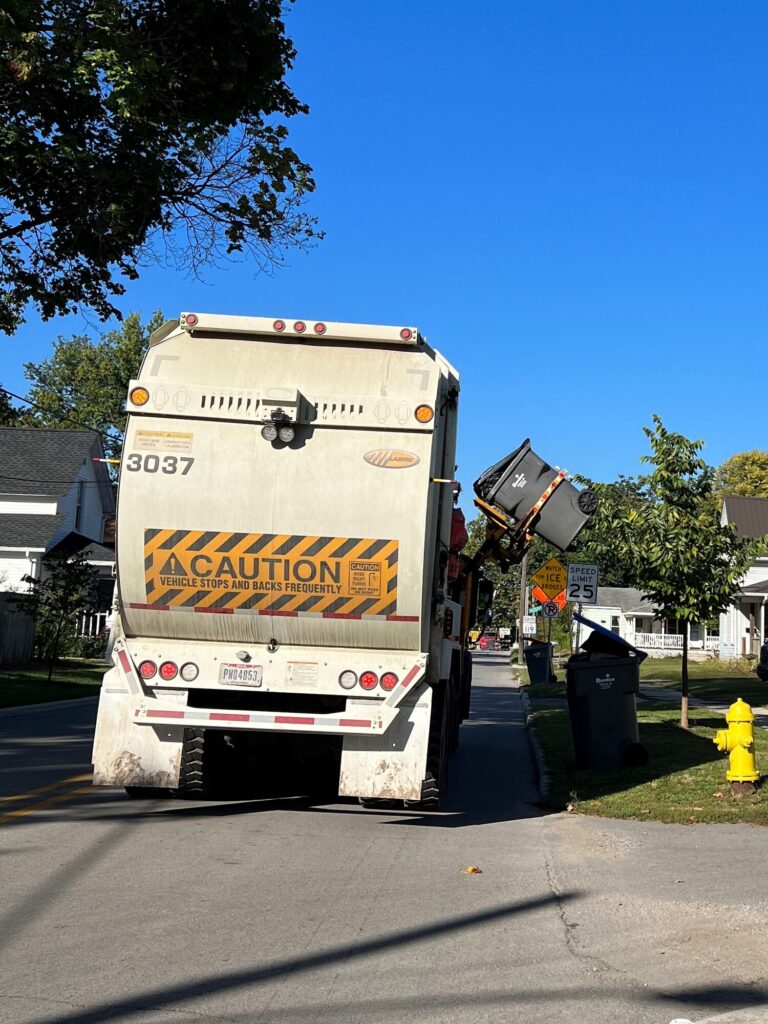
This week, I had the opportunity to learn more about the city’s recent changes to waste disposal. The most obvious change has been the introduction of recycling as a public service, but there are a number of changes that have been made to help make better use of city resources and improve the efficiency of our waste disposal system.
The main change in the city’s contract with Borden Waste Services was from pay-per-weight to a pay-per-unit service. Previously, curbside services were billed to the City based on the total weight of trash collected – this figure doubled between 2016-2022, presenting a serious problem for the City’s budget. By shifting to a per-unit system, the City can provide more value to taxpayers with the added curbside recycling (previously a separate monthly fee) while maintaining nearly identical trash collection services. As Aaron Sawatsky-Kinglsey explained, the addition of curbside recycling should help residents to reduce their solid waste output and minimize pollution throughout the City, and at no extra cost to residents.

Of course, with the new system comes new requirements and challenges. Borden has recently been able to upgrade its trucks to an automated system (pictured below), reducing the strain on its drivers, who no longer have to collect trash by hand. One downside of this system is that the collection arm needs vertical clearance for safety, so some homeowners have had to move their carts for collection. Unfortunately, Borden also uses the carts to track billing, meaning that homeowners have to use the provided carts rather than those they might already have.
So far, the addition of recycling seems to be a positive step: in August, Borden collected 108.45 tons from recycling bins across the city, accounting for about 16% of the City’s solid waste output! Not every recycling route had received bins until September, so this figure doesn’t account for the entire city. Borden predicts that our collective recycling will continue to grow in the coming months as residents become adjusted to the service.
Invasive Species Removal
Posted 9/26/2022 Conrad Liechty, Goshen College Sustainability Student Intern
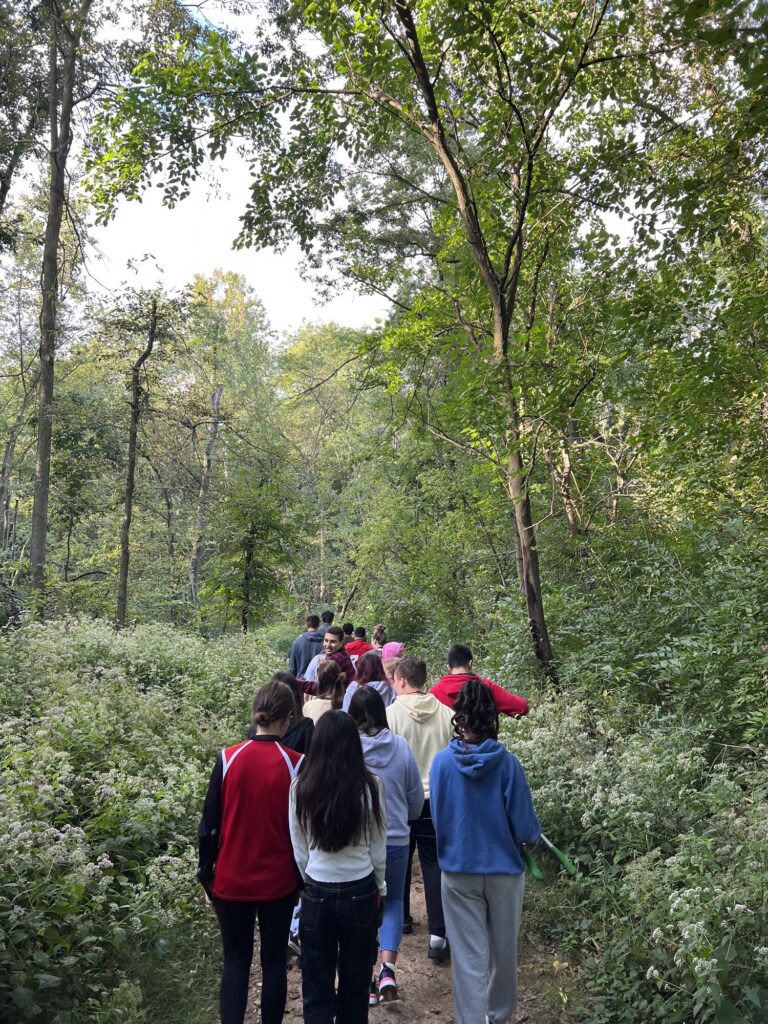
This week, Rieth Interpretive Center was the host to several field trips from Goshen High School’s first-year Biology classes. The class recently finished a unit on human impacts and invasive species (organisms that cause ecological or economic harm in a new environment where they are not native) and joined forestry staff to help with the removal of some invasive species in the Dr. Larry Beachy Classified Forest. We were joined on Thursday morning by Ms. Wohlford’s honors class, who jumped straight into the woods to tackle a number of problem species. Our primary targets were honeysuckle, tree of heaven, burning bush, autumn olive, and privet, many of which the students learned to identify on their own by the end of the morning.
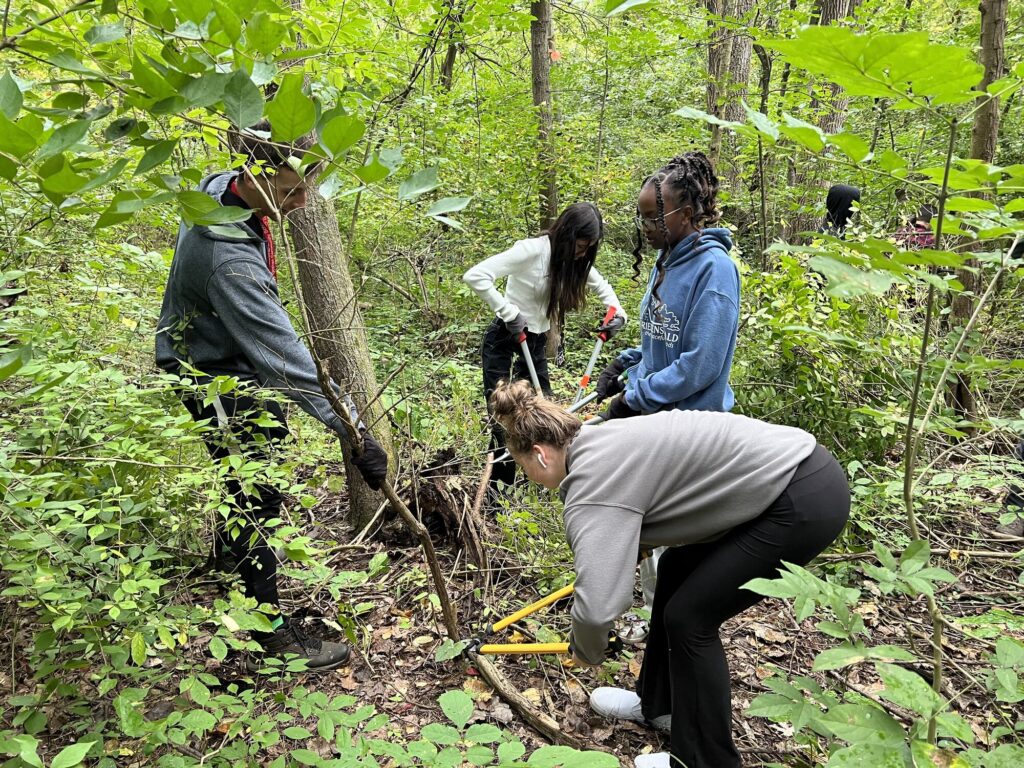
Although fall is typically the hardest time of year to identify invasive species, students quickly learned to pick out the opposite leaves of autumn olive and the squared-off stems of burning bush. They forged off the marked trails to expand their range, some of them getting into sticker and briar bushes in search of more invasives. By the end of their hour-long visit, they had accumulated a sizable pile of cuttings, bushes, and fully uprooted plants. The five different sections of biology students that visited helped to make significant progress in this section of the forest!
While this may have been some students’ first visit to the Rieth Interpretive Center, it most likely will not be their last. The Center’s staff hosts events for students all the way from elementary to high school, inviting them to engage, discover nature, and find out more about the city’s parks. In fact, these high school biology students will most likely return in the spring to learn more about how the ecosystem differs throughout the seasons. While the invasive species may be easier to spot in the spring, they’ll have other topics to focus on, coordinated with their biology curriculum!
Did you know that trees in your neighborhood are taken care of by the city?
Posted 9/20/2022 Conrad Liechty, Goshen College Sustainability Student Intern
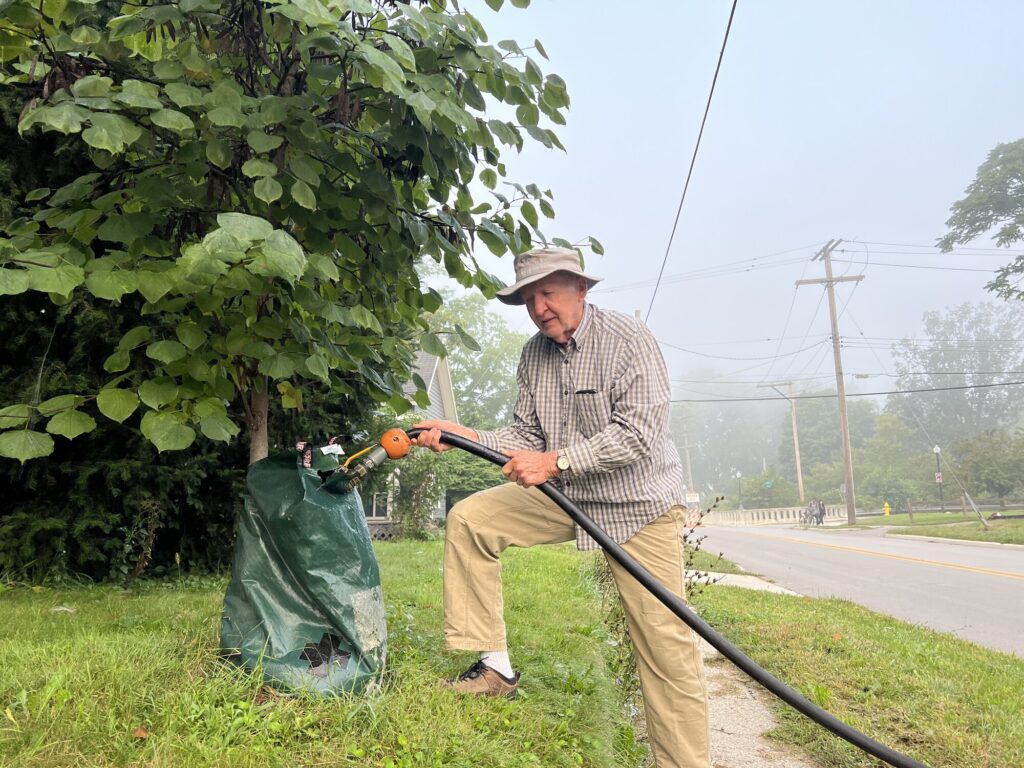
The Department of Environmental Resilience coordinates volunteers during the drier summer months, June – September, to keep younger trees in the City’s right-of-way watered and healthy. This year, the city is caring for 402 trees divided into five different routes. This week, I got the opportunity to ride along on one of the routes and meet Stan – one of the longest-term volunteers – and Roger, a parks employee of 45 years.

Stan originally went to Goshen College and graduated with a degree in biology. After a career in plant pathology, working both abroad and all across the United States, he returned to Goshen to retire. Several close friends, knowing his interest in biology, encouraged him to join the Goshen Tree Board. After serving his time and the introduction of Aaron Kingsley as the city forester, he stepped down from his role with the Tree Board, but continued to volunteer because he loves spending time outside and values the services the trees provide to the city.


We started our day at 8am, as Roger met Stan and I with a city truck and a full tank – roughly 1,000 gallons of water – to get going for the morning. Throughout our time together, Stan and I filled up the bags of 50-60 trees, filling them with 20 gallons each to get through the week. The route for the day took us to the northwest of Goshen, down Greene Rd. and back through Black Squirrel Golf Club. Along the way, Roger and Stan kept tabs on the health of the trees, chatted up residents, and caught up with each other. We ended the morning with less than 100 gallons of water left in the tank, as Stan and Roger prepared to go about the rest of their days. With only two more weeks in the watering season, the city is on track to distribute over 30,000 gallons of water to public trees throughout the summer. Because of the contributions of all of the volunteers, many newly planted trees throughout the city are thriving, providing all sorts of benefits and beautifying the city.